
Every summer, Dave Iben takes his team at Kopernik Global Investors away from the sultry air of St. Petersburg, Florida. They’ve decamped to Belgrade, Budapest, Marrakesh, Tokyo, Lisbon, London, Montreal, and Buenos Aires. This summer, they’ll head back to South America, traveling to Rio de Janeiro.
“It’s important to get out there and see the world,” Iben says. “The stereotypes that we often have in America just aren’t right.”
He cites his personal love of travel as the foundation for what the $9.4 billion firm calls its “global immersion” program. Wanderlust similarly informs Iben’s global investment strategy: At the end of last year, its flagship Global All-Cap strategy’s top holdings were in companies based in South Africa, Canada, South Korea, Germany, Singapore, and Australia, as well as the U.S.
The firm is named after the Renaissance polymath who discovered that the world revolves around the sun rather than the earth: Mikolaj Kopernik, more commonly known as Nicolaus Copernicus. Kopernik, the firm states, “placed his hands-on analysis above the zeitgeist of the public at large.”
That’s a hint that Iben is an iconoclast, which in this day and age means a value investor — one following a strategy that has been out of favor in an era where big U.S. tech names have pushed the S&P 500 to record highs. And for some time, it’s the international markets where Iben has found value.
Take South Korea. “A year ago, almost 20 percent of our portfolio was in South Korea,” he says. Remarkably, Iben notes that the country is still classified as an emerging market on Wall Street. After spending two weeks of meetings there in 2024, Iben came away thinking that the people running businesses are sharp, the culture is education-driven, and the infrastructure is strong. “It just didn’t feel like an emerging market at all. It’s a strong economy.” (Kopernik has about 40 percent of its investments in what are classified as emerging markets, including South Korea.)
Other investors are finally starting to recognize that the world is bigger than the United States. Last year, as investors began to sour on the U.S., international markets outperformed after lagging for many years. Kopernik’s Global All-Cap mutual fund, whose shareholders are largely institutions, had a blowout year, gaining 65 percent. The MSCI All Country World Index grew by 22.87 percent, compared with the S&P 500’s 17.9 percent.
To protect Global All-Cap’s success, Kopernik decided to close the fund to new investors, with the firm preparing to offer a new global fund based on mid- to large-cap companies.
As it looks for beaten-down names, Kopernik has tended to focus on natural resources, whether in mining or energy, from precious metals to oil. “Over the past 20 years, resources have been undervalued,” Iben says. He prefers to check things out himself. “Rather than standing next to it, we like to see hundreds of millions of dollars of equipment and mills and roads and infrastructure.”
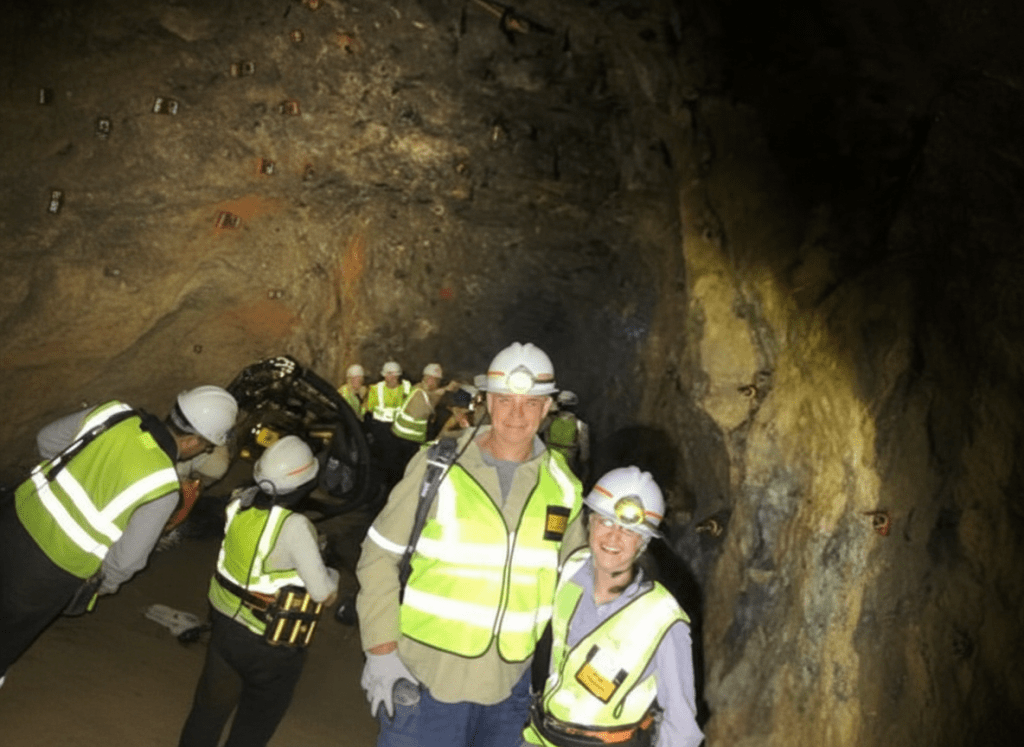
In the Democratic Republic of Congo, Iben — who is in his 60s — even climbed down into a copper mine that was under development. Says Kenneth Morgan, Kopernik’s head of global trading, “Dave wanted to go see it because if it ever did go public, he wanted to understand what the conditions are there.”
For the rest of my profile, please go to Institutional Investor at this link:
https://www.institutionalinvestor.com/article/value-iconoclast-0
 Michelle Celarier